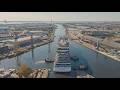

The GalataPort project, opened in 2021, cost $1.7 billion and provides, on the shore of the Bosphorus, a cruise terminal, a shopping center with hundreds of stores, a hotel, and even a modern art museum designed by Renzo Piano.
Article from CruisesNews magazine no. 60 – March 2022

Tourism in Turkey:
In 2019, Turkey ranked among the top 10 most visited countries. That year, 51,191,882 international tourists traveled to Turkey. The number of tourists visiting Turkey increased by 5,423,882, or 11.85%. The main sources of tourism to Turkey are Russia (13.01%), Germany (9.75%), and Bulgaria (5.21%). Turkey ranked sixth in the world for tourism that year. Three Turkish cities are among the top 100 tourist destinations worldwide, with Istanbul standing out. In 2019, Istanbul ranked ninth among the most visited cities, attracting over 14.72 million tourists. Most of them arrived through its new airport, opened in 2018 and designed as the largest in the world, located on the European side of the city, with links to 146 destinations in 120 countries less than three hours away by plane, thanks to its strategic position between Asia, Europe and Africa.
Some of the main representatives of the Turkish tourism industry are optimistic about 2022, for which they estimate that they will have similar visitor figures to 2019.
In fact, according to Firuz Bağlıkaya, president of the Turkish Travel Agencies Association (TÜRSAB), they estimate that there are already nearly 10 million advance bookings for 2022. The main source markets are the United Kingdom, Germany, Ukraine, and Russia.
Political Instability in Turkey.
In 2013, 689,417 cruise passengers visited Istanbul on 381 cruise ship calls at the aging Salı Pazarı terminal in Karaköy. This number began to decline in 2014, reaching 518,935 passengers, and then rose to 589,314 in 2015, a year in which it was expected to surpass 600,000 cruise passengers, with a 45% increase in turnaround operations.
In March 2016, a PKK attack in Ankara left 37 dead, and on June 28 of that year, another terrorist attack at Terminal 2 of Istanbul's Atatürk Airport resulted in 45 deaths and hundreds of injuries. Adding to this the failed coup attempt in Turkey on the night of July 15-16, 2016, by some factions within the Armed Forces to overthrow President Recep Tayyip Erdoğan, Turkey was plunged into an unprecedented spiral of political instability. It is well known that tourism in general, and cruises in particular, avoid this type of situation. The result was devastating: in 2017 there were only four cruise ship calls in Istanbul, and none in 2018.
On June 6, 2019, a cruise ship, the Seven Seas Voyager, docked in Istanbul, the first in almost four years, at the Sarayburnu pier, opposite the Galata pier.
That year Istanbul only had 24 cruise ship calls. And 80 were expected for 2020, but then the pandemic hit and cruise ship arrivals stopped again.
The historic Galata dock
: Construction of the docks in the Galata area began after Frenchman Marius Michel obtained a 75-year concession to operate them. Work started in April 1892 under the direction of French engineers Duparchy and Diricq. In December 1895, 758 meters of berthing line, constructed of 20-meter-wide concrete blocks, were completed. It was inaugurated in March 1896.
In 1907, construction began on new buildings for customs, port offices, external health services, sheds and warehouses, which occupied 7,000 m2.
In the early 1930s, a surge in the number of ships visiting Istanbul led to a significant increase in passengers and cargo, overwhelming the capacity of the existing piers and passenger terminals. To alleviate the resulting congestion, several changes were made to the Galata Pier, the most important of which was the construction of a passenger terminal. In 1936, architect Rebii Gorbon won a competition to design the new Karaköy Passenger Terminal. Because the site was reclaimed land, piles were used to support the foundation. The Passenger Terminal finally opened on July 1, 1940, and remained operational until May 2014, which also partly explains why 2013 was Istanbul's record year for cruise ship arrivals.
In 1958, four warehouses designed by Sedat Hakkı Eldem were built. These four warehouses occupied an area of 30,175 square meters and had a constructed area of 78,810 square meters, with 1,750 meters of berthing line. They remained in use until 1987, when cargo operations were transferred to other docks on the Asian side of Istanbul, rendering all these facilities obsolete and leaving them used only for cruise ship berthing. In 1982, the area was declared a site of tourist interest. In 1993, the Conservation Board declared the area urban and it was declassified, and efforts began to repurpose it. The first references to what would later become GalataPort appeared in 2001, seeking a concept that combined cultural, tourist, and transportation uses. Thus, in 2004, for example, one of the sheds was converted into Istanbul Modern, Istanbul's first modern art museum.
Awarding of the Operation:
The first tender for the construction of GalataPort was launched in September 2005 by the Turkish Maritime Administration, and was won by a consortium led by Royal Caribbean Cruises with a bid of €3.538 billion. However, the Turkish Ministry of Culture and Tourism challenged the rezoning of the area to allow the construction of GalataPort. The courts ruled in favor of the project's opponents, and the tender was annulled. Eight years later, a second tender was launched to design, build, and operate GalataPort. On May 16, 2013, the contract was awarded to Doğuş Holding (one of Turkey's largest conglomerates, with interests in various sectors) with a bid of $702 million. On January 5, 2014, Salipazarı Port Management & Investments was established between Doğuş Group and BLG Capital, a subsidiary of Bilgili Holding, Turkey's leading real estate developer and tourism investor.
Since February 2014, this company began its activities as the manager of the GalataPort project, which began construction in February 2015. Four years later, on February 14, 2018, the company's corporate name changed to Galataport İstanbul Liman İşletmeciliği ve Yatırımları A.Ş.
There were many engineering challenges, but perhaps the most significant was that GalataPort wasn't built by the sea. It was actually built in the sea, on former landfill.
In May 2017, the concept for GalataPort's underground terminal, with concealed ramps, was finally unveiled. This design meant that only 3.5 meters of dock width were needed when cruise ships were in port, leaving the rest available for other uses. When no cruise ships were in port, the entire area was open to the public.
The GalataPort project will represent an investment of 1.43 billion euros for Dogus Group and Bilgili, making it the largest cruise terminal project worldwide.
The design of GalataPort
prioritized ensuring the absence of archaeological remains, especially in a city like Istanbul. To this end, excavations were carried out, but no significant historical vestiges were found beyond the historic buildings that needed protection. GalataPort is located 500 meters from the Galata Tower and 900 meters from Taksim Square.
GalataPort is designed to revolutionize Istanbul's waterfront and, in the long term, even the local economy itself. On paper, GalataPort has many of the characteristics of today's megaprojects: 100,000 square meters of built space, 250 shops, parking for 2,400 vehicles, a 177-room Peninsula hotel, a museum designed by Renzo Piano, and perhaps most importantly, 1.2 kilometers of docking line that can be transformed into a public waterfront promenade, after having been inaccessible to Istanbul residents for over 200 years. These docks can accommodate two mega cruise ships operating as homeports, plus two more in transit.

On paper, the transformation of Istanbul's port facilities should have a similar impact to that of Port Vell in Barcelona, HafenCity in Hamburg, or Canary Wharf in London. Following an international competition, Dror + Gensler was selected to develop the project, collaborating with local landscape architects Tanju Özelgin and Arif Özden of TO Studio, and BAE Architects, the Miami-based architecture and engineering consultancy specializing in cruise terminals (such as Barcelona's Terminal B), to develop the underground terminal and all the flows of passengers, baggage, vehicles, etc., within it. The interior finishes of the cruise terminal were the work of Autoban.
But GalataPort has also been revolutionary, adopting a radical change in the way a terminal is conceived. It is the world's first underground cruise port, designed to handle 15,000 passengers daily and around 1.5 million annually, while the complex is expected to receive 25 million visitors per year. As ships dock, a section of the pavement rotates 90 degrees, hydraulically operated, like a hatch, to provide access to ramps that descend to customs and passport control. Simultaneously, these movable walkways serve a secondary purpose as security barriers to restrict access to the port area. This system for opening the dock area to the public when no ship is present had previously been used successfully in San Francisco. Rather than an architecturally iconic terminal, GalataPort is built downwards, inspired by the monumental cisterns of Istanbul, but functioning more like an underground parking garage. Strictly speaking, the functions of a cruise terminal are relatively simple: security checks, baggage handling, and transfers to the airport; or, if it's a stopover, security checks and directing passengers to their coaches for optional excursions. GalataPort's underground design doesn't preclude any of these functions. There are five moving walkways connecting the terminal to the pier, as well as 32 passport control booths, 22 boarding pass turnstiles, 22 scanners, and so on.
This concept will be used for the first time worldwide. Passengers arriving in Istanbul will disembark from the ship via a gangway onto the pier and enter a ramp that will take them to the passport control and customs area in the underground terminal. There are no jetways or walkways, giving the complex a commendable architectural simplicity. However, the complex is equipped with 89 elevators and 37 escalators.
This creates an area that complies with the 2002 ISPS Code on port security, and creates a duty-free customs zone using a mobile fence made up of 176 pieces 3 meters high, thanks to a hydraulic rotary actuator system.
This area will be open before the cruise ships dock, allowing the public to enjoy the waterfront. During cruise ship docking, hydraulic rotating actuators are operated remotely to create a duty-free zone.
The project's restaurants and shopping arcade are located in the restored former Post Office. The total number of retail and dining outlets planned for the project includes 93 shops, 21 restaurants, two à la carte restaurants, a supermarket, seven cinemas, and more. The total leasable area for retail and dining is approximately 52,000 m², including circulation areas. GalataPort not only renovated the post office building but also meticulously restored every single slate roof tile—some 25,000—and the entire early 20th-century metal structure.
Three protected buildings—Merkez Han, Karakoy Passenger Terminal, and Çinili Han—are also being restored to house the 177-room Peninsula Istanbul Hotel, located next to the shopping center. The hotel belongs to the prestigious Peninsula Hotels chain, which operates in only ten cities worldwide and has joined the project not only as the operator but also as a 50% investor. The Peninsula Istanbul will also feature a 750-square-meter shopping arcade with nine luxury brand stores.
Costa Cruises is the shipowner that has invested most heavily in GalataPort, basing the Costa Venice in its docks from May 2022 to May 2024.
Tophane Square has been reconstructed as part of the project and transformed into one of Istanbul's most important squares. Within GalataPort, it serves as the link between the Istanbul Modern Museum, designed by Renzo Piano (the architect of the Botín Centre in Santander), and the Museum of Painting and Sculpture of the Faculty of Fine Arts at Mimar Sinane University in Istanbul. A clock tower, originally built in 1848, has been restored in the square, and its central location is a defining feature of the project. The square will remain vibrant and lively with a year-round program of events encompassing art, design, and fashion, becoming a major attraction for both Istanbul residents and tourists.
Returning to the cruise terminal, burying the building is a smart and practical consideration that respects the urban fabric. Every infrastructure project of this type is conceived as a monumental gateway, often without a broader perspective on its impact on the urban fabric, even on a city's skyline, which is highly sensitive. Perhaps GalataPort represents a more evolved level of urban planning, where the city and its use take precedence over the monument. It's possible to do things that traditionally can only be done one way.
The architects saw this tear in the urban fabric and wove it back together: continuing the city's axes, they were sensitive to building heights and the rhythm of human-scale design. They made Istanbul the jewel, the star, with the concept of an underground cruise terminal, rather than any glass volume dreamed up by a star architect. GalataPort is a design without ego.
A sustainable complex thanks to technology.
One of the project's criteria was its environmental commitment. The result has been very satisfactory. The Salipazari site, where the cruise terminal is located, was awarded LEED Gold certification, and the buildings in the Karaköy area received BREEAM Excellent Target certification.
During both the design and construction phases, everyone involved played a crucial role in ensuring the project's external recognition of its sustainability. Every precaution and action was taken to improve energy efficiency, reduce water consumption, and lower carbon emissions. Greywater recovery was also implemented, and the urban heat island effect was mitigated through the installation of green roofs.
Sustainability during the construction phase was equally important, from the on-site treatment of rubble and sediment to the use of local and recycled materials, as well as the selection of materials and chemicals that were not harmful to humans and wildlife. Finally, an environmental monitoring system was installed to track the port's impact on the environment and its social impact, including noise, PM10 particle concentration, dust sediment, and continuous measurement of seawater quality.

Since the terminal is underground, another criterion to consider was sea level rise. In Istanbul, sea levels have risen between 30 and 35 centimeters in the last 100 years, but GalataPort was built to withstand a three-meter rise in sea level. And all the buildings use seawater as a coolant for greater sustainability.
A long and difficult construction
The Project was divided into two packages: Salıpazarı and Karaköy, which were initially two different tenders, although both were eventually awarded to the Italian construction company Trevi, which worked on the ground for more than three years on this project.
The project included in the tender was thoroughly studied by engineers from Trevi's development office, who proposed several technical improvements and alternative solutions, resulting in a more sustainable project strategy and cost savings for the client. Therefore, Trevi acted as the main contractor and proposal designer for all geotechnical engineering work.
The difficult hydraulic and geotechnical conditions of the terrain, its seismic risk, the presence of historic buildings that need to be reinforced, the simultaneous reconstruction of the dock by other contractors and the port operations that were maintained, on a smaller scale, while GalataPort was being built, required cutting-edge technologies in the foundations.
The Salıpazarı package included the construction of an underground cruise terminal, which required excavating the entire 65,000 m² site to approximately 15 m below ground level (13 meters below sea level). The pavement above the terminal was also designed as a waterfront promenade, with walking paths. The foundation work included the construction of a 1,200 mm thick anchored diaphragm wall, built using both mechanical grabs and hydro-mills; extensive ground improvement to combat water seepage, with over 100,000 m of stone columns and 250,000 m³ of treated soil; a pile foundation consisting of 1,000 mm diameter drilled piles; and the implementation of a drainage system for the entire site.
Istanbul and Antalya are the third and fourth most important European tourist destinations, respectively. Antalya, Turkey's tourism capital, ranks twelfth globally with 13.3 million tourists in 2019.
The Karaköy package, in addition to the construction of its corresponding berth, consisted of the rehabilitation of five existing buildings, while the unprotected buildings were demolished. The foundation works within this site consisted of a 1,000 mm thick secant pile diaphragm wall, installed using a mechanical grab; hydraulic sealing of the bottom to reduce groundwater flow during excavation and potential settlement of adjacent buildings, achieved by overlapping 2,000 mm double-fluid grout columns (45,000 m³ of treated soil); and a lattice-type soil improvement against groundwater ingress, composed of elliptical columns (50,000 m³ of treated soil) and a permanent tension micropile mesh to prevent uplift. Regarding the historic buildings that were preserved, the corresponding foundation work had to be carried out from inside them, with reduced free height, and consisted of a massive improvement of the ground by means of a single jet grout (40,000 m3 of treated soil) and structural shoring by means of micropiles (2,000 m), to allow the excavation of a partial basement under the existing foundation.
In both Salıpazarı and Karaköy lots, Trevi installed a massive monitoring system to control the movement and forces acting on the various components of the foundation system, the surrounding terrain, and existing buildings. All of the activities listed above were carried out almost simultaneously, which added further challenges to the project.
First stops at GalataPort
The first stop of a cruise ship was to be made on September 25, 2021 by the Eurodam of Holland America Line.
However, the Dutch vessel cancelled, and the honor of being the first went to the SeaDream II, which called on Friday, October 1, 2021, with approximately 150 passengers and crew, arriving from the Bulgarian port of Varna on the Black Sea. The stopover, which included turnaround operations, lasted two days before it sailed for Burgaz, Bulgaria. GalataPort's next customer was the Viking Sky, which arrived from Kuşadası on October 15 with 500 passengers. The ship sailed on October 18 with a new passenger roster bound for Kuşadası. On November 10, it was the turn of the British vessel Spirit of Discovery, owned by Saga Shipping.
In 2021, only eleven port calls were scheduled, but in 2022, 321 calls are planned at GalataPort, 88 of which will use Istanbul as their home port. The first call of 2022 was made by the Viking Sky on January 5-6. GalataPort's next client will be the Europa on March 18, 2022. The impact of the invasion of Ukraine on port calls from Istanbul remains to be seen. The main result has been the cancellation of Black Sea cruises, but most of the calls are part of Aegean itineraries, with ports in Asia Minor and the Aegean Sea. Furthermore, Turkey is a member of NATO. As of today, the true extent of the war's impact on Eastern Mediterranean cruises is yet to be determined.
Thirteen port calls are scheduled for April, including double calls on April 15 with the Norwegian Jade and the Insignia, and on April 24 with the Seabourn Encore and the Mein Schiff Herz. The Seabourn Encore will be based in Istanbul this coming summer, offering 7-night Istanbul-Piraeus cruises.
Until 2015, Karakoy Pier was the only port in Istanbul where cruise ships could dock. During the construction of GalataPort, there were no other ports in Istanbul where cruise ships could dock.
The first quadruple port call at GalataPort will take place on May 7, when the Viking Sky, Star Clipper, Star Pride, and Celebrity Reflection will all be in port. A triple port call will be scheduled for July 3, with the Seabourn Encore, Costa Venezia, and Oosterdam.
But the most significant investment in Istanbul is undoubtedly that of Costa Cruises with the Costa Venezia. Following its departure from the Chinese market, this ship has been based in Istanbul by the Genoa-based cruise line until 2024. Next summer, it will offer 30 seven-night cruises to the Aegean Sea. From November 2022 to April 2023, it will offer 14 eleven-night sailings to Egypt and the Holy Land. This schedule will be repeated in the summer of 2023 and the winter of 2023-2024.