
A Spanish-infused cruise line for the Indian market. Cordelia Cruises is emerging as a premium, single-ship brand for the Indian market, announcing the acquisition of none other than the Empress of the Seas, a legendary cruise ship. Its parent company, Waterways Leisure Tourism Private Limited, previously acquired Jalesh Cruises, which declared bankruptcy in October 2020, just a year after its launch. It appears that Cordelia Cruises is poised to carry on the Jalesh legacy, offering those special holidays in India and other Asian destinations.
Article from CruisesNews magazine no. 56 – March 2021

The cruise line offers itineraries from two to seven nights to Sri Lanka, the Maldives, and throughout India. Cruising is a relatively new experience in India, and the target customer is quite discerning. Cordelia aims to promote and enhance cruise culture in India through elegant, luxurious, and, most importantly, inherently Indian experiences. It's a cruise for Indians, tailored to the way Indians love their vacations.
At the helm of operations, as Chief Operating Officer, is Spaniard Amado Alberto Franco, who previously managed operations and finance at Jalesh and comes from Pullmantur Cruises, where he became familiar with the Empress. Amado is an industrial engineer with a master's degree in logistics and business administration, in addition to advanced studies in various industrial, financial, and management disciplines. He has experience in the industrial, aviation, and tourism sectors, having managed diverse projects from around the world. He is now based in Mumbai.
How does a Spanish professional from a company with such a distinctly Spanish product end up working for a company focused exclusively on the Indian market?
Having the opportunity to build a company from scratch in a market as complex as India is incredibly exciting professionally, and a challenge I had to accept. The company's objective is simply to offer a service tailored to the tastes and needs of a very specific clientele. The foundation of my previous work in the cruise industry is no different from my current role. The difference compared to my past experience lies not in the service concept but in the product itself. We tailor it to the market's preferences, relying, of course, on a large team of professionals and companies with extensive knowledge of the country's gastronomy, services, and entertainment.
What's the key to this market compared to the Spanish one?
Cruises in India are relatively new and still largely untapped. The average passenger age is very young, 37 years old compared to the global average of 65, and the vast majority choose short cruises, between two and four days. The key is differentiation. We tailor our entire product to the tastes of Indian customers and offer short cruises departing from the country's main ports to the top tourist destinations in India and Sri Lanka. This allows us to position ourselves in a market segment where no other cruise company is present.
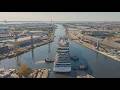
Cordelia Cruises acquired the Empress of the Seas to operate cruises focused on the Indian market.
Our customers don't need international flights or the long vacations they're so unaccustomed to compared to Western countries, and they feel right at home. We are undoubtedly the cruise line with the widest variety of vegan and traditional Indian dishes, and the only one with shows that reflect the country's culture. Like the Spanish market, the Indian market has a very distinctive cuisine and a unique culture. No other competitor tailors service, food, and entertainment to the tastes of Indian consumers on board their ships.

The vast majority focus on selling the destination. They adjust the food and onboard service to international standards to try to satisfy most passengers, although, as always, it's never possible to satisfy such a diverse audience. Our target market is very specific, with a value proposition highly tailored to their tastes.
Jalesh Cruises declared bankruptcy just months after its launch and almost simultaneously created Cordelia with the same executive team at the helm. Has the shareholding structure changed at all? Was Jalesh not viable, while Cordelia is?
The cruise sector is perhaps the one most affected by the crisis. Cruise companies went from zero revenue almost overnight, without warning. A large cruise ship can require more than a million dollars a month. For any startup like Jalesh trying to position itself in a new market with unforeseen events of this magnitude, this is a very difficult challenge to overcome, unlike what is happening with large cruise companies that have better access to capital markets and are managing to stay afloat by financing their losses in the long term.
Cruises in India are something new and a market still to be exploited with an average passenger age of 37 years.
Taking advantage of the now positive outlook with the arrival of vaccines, the highly competitive prices of used ships, and the Indian government's discounts of up to 70% on port fees, Cordelia Cruises is looking to position itself in the Jalesh Cruises segment. To this end, it is acquiring the brand, a ship to operate, and part of its management team to develop an improved and even more customized product. A time of crisis, a time of opportunity.
You recently acquired the Empress of the Seas from Royal Caribbean, a ship that was also part of the Pullmantur fleet. Did the ship require any special renovations to adapt to the Indian market?
I'm fortunate to have worked with the Empress previously during my time at Pullmantur. Therefore, we were already familiar with the ship, and it perfectly matches the characteristics, condition, and onboard infrastructure we were looking for. The focus isn't so much on refurbishing the ship itself, but rather on designing and implementing services, food, and entertainment specifically tailored to our market, which sets us apart. Along with rebranding the spaces, the most significant renovation is in the casino, with an almost complete overhaul of the equipment and infrastructure to cater to the tastes of our target audience.
They've announced their first itinerary starting in June. Will Cordelia require pre-cruise vaccinations?
In the long term, yes. In the medium term, with the current vaccination rate, until a large part of the population is vaccinated, at least some testing will be required before boarding. The crew is equally important, and we're already working to ensure our entire crew is fully vaccinated from the outset.

What has been the biggest challenge for you in these years working for Jalesh and now for Cordelia?
This crisis is undoubtedly the biggest challenge in the history of the cruise industry and a very difficult experience as a professional, with extraordinary situations during border closures. If we focus on the periods before the crisis, opening a business from scratch and developing new tourist destinations in a country like India with so many complexities and infrastructure deficits was certainly a great challenge. Looking ahead, managing a project in such a delicate and uncertain situation as the current one, where any small unforeseen event can affect the entire effort, is undoubtedly a challenge. This is forcing us to raise all our efforts and standards and to be very cautious in everything we do.
We are working to ensure that our entire crew is fully vaccinated from the start.
Are there expansion plans in the works, or have you devised a one-ship strategy that doesn't seem profitable for Western companies?
The goal, like any cruise company, is to grow to take advantage of economies of scale while maintaining a competitive edge in the Indian market to avoid falling into price competition along the way. India is a developing market with enormous growth potential. In the years leading up to the crisis, passenger volume in India was growing at a rate of 24% annually, reaching 200,000 passengers per year. If we look at what happened in China over the last ten years—a country with a similar population, although still far behind in per capita income—passenger volume jumped from India's current figures to 2.3 million passengers per year, largely due to companies that began positioning capacity from China's main ports.