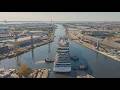

The Helix Cruise Center opened in Barcelona last May.
Article from CruisesNews magazine

This is the second terminal operated under a private concession for preferential use by Carnival Corporation cruise ships, the world's largest leisure cruise company. The first joint terminal was Palacruceros (Terminal D), opened in 2007 and later expanded.
The inaugural event featured key players Arnold Donald, CEO of Carnival Corporation; Julio Gómez-Pomar Rodríguez, Secretary of State for Infrastructure, Transport and Housing of the Ministry of Public Works; Enric Millo i Rocher, Government Delegate in Catalonia; Ricard Font i Hereu, Secretary of Infrastructure and Mobility of the Government of Catalonia; Agustí Colom, Councillor for Tourism, Commerce and Markets of the Barcelona City Council; José Llorca, President of State Ports; and Sixte Cambra, President of the Port of Barcelona.

This project began six years ago, encompassing the negotiation phase, the design and development of the detailed plans, and the various bidding processes for the execution of the work. Following a competitive bidding process, the architectural firm Battle i Roig Arquitectura was selected. Together with its partners Static Ingeniería SA (structural engineering) and PGI Engineering (mechanical and plumbing engineering), Battle i Roig Arquitectura developed the preliminary design, which was approved by the Port Authority of Barcelona, granting the concession in July 2015. By the summer of 2016, the detailed plans were finalized, and the foundation stone was laid in September of the same year.
The port has been an essential element in trade and in Barcelona's links with the world.
The main feature of the new building is “the balance between functionality and ergonomics: on the one hand, providing spacious, flexible, and well-organized circulation routes within the complexities of building in a maritime environment, and on the other hand, ensuring that the building's volume and facade system create high-quality spaces, avoiding excessive sunlight and overheating of interior areas,” according to the Batlle i Roig firm. At 12,500 square meters, the HELIX terminal is the largest in the port and is expected to handle more than one million passengers annually. The shipping company's investment in this project is €46 million
With the opening of the Helix Cruise Center, Carnival Corporation expects to welcome more than 1 million guests a year.
Why the name HELIX CRUISE CENTER? According to the Port of Barcelona's tradition, all terminals must have a name. But which one? A name that was easy to pronounce in all languages, short, and of course, contained the letter E. As Sandra Yunta, director of the Palacruceros and HELIX terminals, explains: “During a site visit, the architects showed us a small plaque with the terminal's predominant color – Helix color – Helix means the same thing in English and Catalan, so we had found the name.”
A global company for an ever-changing industry,
Carnival Corporation has a portfolio of 10 of the world's most popular cruise brands, with 103 cruise ships visiting more than 700 ports worldwide. These brands include Carnival Cruise Line, Holland America Line, Princess Cruises, Seabourn, Costa Cruises, AIDA Cruises, Cunard, and P&O Cruises.

With the opening of the Helix Cruise Center, Carnival Corporation expects to welcome more than 1 million guests annually, further solidifying the Port of Barcelona's position as one of the world's premier embarkation and disembarkation ports. Carnival Corporation will also operate the first public parking facility located at the cruise pier, with nearly 300 parking spaces. Almost half of the cruise passengers who visit the Port of Barcelona begin and end their cruise in Barcelona, a significant economic benefit for Catalonia and the city. According to a study by the University of Barcelona, nearly a third of all cruise passengers spend an average of 2.8 days in the city before or after their cruise and spend around €230 per day during their visit
Improving Air Quality:
The HELIX terminal will receive the next generation of eco-friendly ships that use liquefied natural gas (LNG) as fuel. Carnival Corporation is deeply committed to environmental improvement and is an active participant in the pioneering "air quality improvement" plan proposed by the Port of Barcelona in November 2016 to effectively reduce emissions generated by port activities. The report confirms that Carnival Corporation is on track to achieve its goal of reducing CO2 emissions intensity by 25 percent. Furthermore, the company is close to meeting its additional sustainability targets for the next three years. In addition to its ships, which will be pioneers in the use of LNG, the company has also been at the forefront of significant progress in modernizing existing ships with exhaust gas cleaning systems that improve air emissions and reduce sulfur compounds and particulate matter in the combustion gases. In addition, nearly 40 percent of the fleet was already equipped with shore power capabilities in 2016, allowing ships to utilize an alternative energy source while in port. Carnival Corporation offers its guests extraordinary cruise vacations while maintaining a deep commitment to protecting the oceans, seas, and destinations its ships visit.

Sixte Cambra, president of the Port of Barcelona, assured that the HELIX terminal will become an international benchmark, "not only for its design, but also for its commitment to sustainability, in line with the port's environmental strategy.".
Barcelona, a benchmark.
Barcelona is already a benchmark in the use of LNG (for ships, trucks, and terminal machinery) to promote energy efficiency, reduce NOx by 85%, and eliminate particulate matter and sulfur oxides. Current activity at the Port of Barcelona, including cruise ships, emits 7.6% of NOx (nitrogen oxides) and 1.2% of PM10, the most polluting particulate matter.
Eight Carnival Corporation brands – AIDA Cruises, Carnival Cruise Line, Costa Cruises, Cunard, Holland America Line, Princess Cruises, Seabourn, and P&O Cruises – regularly visit Barcelona, and six of them use the city of Barcelona as a total or partial base in their operations in 2018.
On the way to the Helix Cruise Center terminal,
the Port of Barcelona has been one of the most important commercial ports in the Mediterranean for over 2,000 years. A vital part of Barcelona's history, the port has been essential to trade and to Barcelona's connections with the world. A port steeped in history, yet relatively new to the cruise industry. Even so, in recent years Barcelona has become one of Europe's leading destinations and one of the most sought-after ports of call for cruise passengers, who fall in love with Catalonia's architecture, cuisine, culture, and people.
To understand the Port's upward trend, one must go back to the 1992 Barcelona Olympics. The city underwent significant changes: the World Trade Center, the Logistics Activities Zone (ZAL), the Palau de Mar, etc. Faced with a significant shortage of hotel rooms, not only in the city but also for many kilometers around, a large fleet of cruise ships docked at Barcelona's docks for the Olympics, serving as floating hotels. Furthermore, this year was also significant for the Port in terms of internal transformation. The Government created State Ports to control the port system, making it a unified entity. Thus, the governing body of the Port of Barcelona was renamed the Port Authority of Barcelona (APB).

In 20 years, the Port of Barcelona went from 150,000 cruise passengers in 1993 to 2.5 million in 2013. Strengthening the Port of Barcelona as a homeport was the next step. Currently, more than 54% of cruise ships use Barcelona as their homeport. For example, eight Carnival Corporation brands – AIDA Cruises, Carnival Cruise Line, Costa Cruises, Cunard, Holland America Line, Princess Cruises, Seabourn, and P&O Cruises – regularly visit Barcelona, and six of them used the city as a full or partial base for their operations in 2018.
The report confirms that Carnival Corporation is on track to achieve its goal of reducing CO2 emissions intensity by 25 percent.
The next challenge they set for themselves was to reduce the seasonality of cruise activity as much as possible. In 2017, activity grew by 1% overall, but in the months of January, February, March, November, and December, the increase was 13%. Another success achieved.
In the last eight years, cruise passengers visiting Barcelona have numbered between 2.5 and 2.7 million annually. The Port of Barcelona is the leading port in Europe and the Mediterranean. (Currently, the Port of Barcelona is the fourth most popular homeport in the world, after only three ports in Florida: Miami, Port Canaveral, and Port Everglades).
The balance between functionality and ergonomics: on the one hand, having wide, flexible and orderly circulation within the constructive complexity of building in a maritime environment, and on the other hand, that the volume of the building and its facade system generate high quality spaces, avoiding excessive light and overheating of interior spaces.