
Growing up and becoming a regular and recurring cruise port on Mediterranean itineraries has always been the milestone to be achieved by the Tarragona port authority.
Article from CruisesNews magazine

The cruise tourism sector was almost nonexistent in the Port of Tarragona. Counting the cruise ships that docked in Tarragona each year was a simple task.
In 2013 and 2014, only three cruise ships approached the dock, and in 2015, the number didn't even reach a dozen. The port authority's commitment to gaining a foothold in this sector, and especially the arrival of an Italian cruise line, significantly increased cruise ship traffic in Tarragona. The 2017 season closed with 37 cruise ships carrying more than 51,000 passengers, representing a 284% increase compared to 2016.
Cruises represent a great opportunity for commerce, hospitality and experiential tourism.
To achieve this goal, the port is leading a collaborative team. This working group includes representatives from institutions such as the Tarragona Provincial Council's Tourism Board, the Tarragona Municipal Tourism Board, the Reus City Council, the Tarragona Chamber of Commerce, Industry and Navigation, the URV's Faculty of Geography and Tourism, the FEHT (Federation of Hospitality and Tourism Businesses of Tarragona), and PortAventura World Parks & Resort. The result of this extensive collaborative effort came to fruition in 2014 with the creation of the Tarragona Cruise Port Costa Daurada brand, which has achieved increasingly better results year after year.
In 2018, we can confidently say that the Port of Tarragona had a fantastic cruise season, with final figures exceeding initial forecasts. Specifically, at the end of 2017, a 49% increase was projected, with 55 cruise ships and 80,000 cruise passengers. Given how the season has progressed, as of the end of August, it seems that these figures will fall short.
Homeport:
In September 2016, the first homeport operation began. The transition from a port of call to a port of embarkation represented a significant leap forward for the port authority's operations.
The increase in cruise activity has an estimated economic impact of €3.9 million on the region. This figure is calculated based on the fact that passengers arriving as a homeport spend an average of €120, while those making port calls spend an average of €65.

The key to its success lies in an excellent relationship between public administrations, business associations, and the private sector, all working together towards the same goal: positioning the port as a cruise destination as a region dedicated to offering cruise passengers an unforgettable experience. In the words of Josep Andreu, president of the port authority, “It is everyone’s responsibility: the Port Authority, the Tourism Department, the Chamber of Commerce, taxi drivers, tour guides, restaurateurs, businesses, and the citizens, who must embrace the project.”.
Costa Cruises: A Boost for the Port of Tarragona.
The Italian cruise line Costa Cruises has been a major boost for cruise activity in the city of Tarragona. It has also represented the success of a global model of sustainable tourism, which emphasizes environmental and ecological protection.
The relationship began in June 2017 with the arrival in Tarragona of the Costa neoRiviera (8,200 tons and capacity for 1,727 passengers). It operated Mediterranean itineraries from June to September. In 2017, almost 29,000 passengers had the opportunity to enjoy this itinerary, generating an estimated economic impact of €2,200,000.
The Tarragona Costa Daurada cruise port has established itself in the cruise world as a leading Mediterranean destination. The region of Catalonia known as the Costa Daurada, and its capital, Tarragona, located about 100 km south of Barcelona, will undoubtedly become one of the cruise destinations to watch closely in the coming years.
In 2018, Costa Cruises reaffirmed its commitment to Tarragona with an enhanced offering. The Italian company replaced the Costa neoRiviera with the Costa Victoria. This change increased Costa Cruises' capacity by 34%, meaning that by the end of the year, up to 39,000 passengers will have passed through the port in transit or embarking, significantly improving the economic impact on the region. Both parties have considered these two years of collaboration to be positive. At the 2018 season presentation, held aboard a Costa Cruises ship, the then President of the Port Authority of Tarragona, Josep Andreu, highlighted the cruise line's role in the development of the cruise sector. "We thank Costa Cruises for the confidence they have placed in Tarragona and the Costa Daurada," he said, adding that "working with Costa has allowed us to acquire invaluable know-how to face future challenges.".

At the same event, Raffaele D'Ambrosio, General Manager of Costa Cruises for Spain and Portugal, also spoke highly of the Port of Tarragona. “At Costa Cruises, we are delighted to expand our operations in Tarragona, a destination that perfectly combines all the necessary elements to attract visitors: a rich cultural, gastronomic, and entertainment scene, a wide range of shore excursions, and excellent connectivity. Thanks to the outstanding collaboration of all our partners, it is becoming a leading cruise destination in the Mediterranean.”
For the 2019 season, Costa Cruises will continue working with the Port of Tarragona, marking their third year together. This year, the Costa Victoria will be replaced by the Costa Fortuna, increasing capacity to 3,470 passengers. Eighteen cruise ship calls are scheduled from Sunday, May 26, 2019, to September 22, 2019. This could bring the total number of cruise passengers to over 62,000, 10,000 more than projected for this year, and that's just from the Italian cruise line.
If next year's projections are met, the psychological milestone of 100,000 cruise passengers could be reached, making Tarragona the second busiest port in Catalonia for cruise passengers, ahead of Palamós.
Cruise Passenger Profile:
We have two main profiles for cruise passengers visiting the Port of Tarragona: During peak season, the typical profile leans towards families, aged between 35 and 54, who usually travel with children. In the off-season, the average age tends to rise, and children are less common.
By nationality, 38% are Italian, 23% Spanish, 13% British, 5% French, 7% a mix of German, Swiss, and Austrian, and 9% other nationalities.
According to the Port Authority, passenger satisfaction is paramount for Costa Cruises.
The majority stay within the region. According to a survey of cruise passengers this season, only 4% take one of the excursions to Barcelona offered to them. The remaining 28% embark or disembark, while around 68% decide to visit Tarragona on their own (48%) or take an excursion around the province (20%), which also includes guided tours of Tarragona.
Facilities
: The Port of Tarragona has an exclusive berth for cruise ships, where two cruise ships can dock simultaneously, in addition to the Port Tarraco marina for smaller cruise ships.
The Cruise Terminal is located on the Levante Dock. This facility, 707 meters long with a draft of 19 meters, includes a reception area adapted for people with disabilities, internet access, two waiting rooms, and the option to add catering services (snacks and drinks) for passenger comfort.
For smaller vessels, up to 140 meters in length, the port offers the Port Tarraco Marina facilities, as previously mentioned. This dock is 350 meters long with a draft of 8 meters.

During the season, the port offers a shuttle bus service for cruise passengers to and from the city center.
Another transportation option is the Tarraco Tourist Train, which allows you to experience the city from a different perspective. This train takes passengers to the historic city center and returns them to the Port of Tarragona. The audio guide for the panoramic tour of Tarragona is available in eight languages.
Tarragona, a World Heritage Site.
Legend has it that the god Jupiter abandoned his wife, the earthly Tyria, after falling in love with Tarragona. What is not legend, but pure reality, is the impact it had on Imperial Rome.
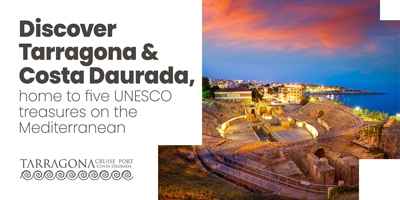
That is why the Romans chose it to found their first fortification beyond the Italian Peninsula, in the 3rd century BC. Its main monuments from that glorious era bear witness to this: the Amphitheater; the Walls, of which a kilometer remains; the Circus; and the Aqueduct. This well-preserved archaeological complex earned it UNESCO World Heritage status in 2000.
2019 Goal: to surpass the 100,000 passenger mark.
But Tarragona is not just a vast open-air museum. In addition to its tangible cultural heritage, it boasts two other intangible treasures. Since 2010, these have been the Castells, human towers that are a defining feature of Catalan tradition and have a prominent place in Tarragona. This is especially true during the Santa Tecla festival in September and on the first Sunday of October in even-numbered years, when the city's bullring hosts a spectacular competition featuring the main Castells teams from across Catalonia.

However, although almost everything in Tarragona begins in Rome… nothing ends there. Its Medieval Route allows you to admire the 14th-century Romanesque Cathedral with a Gothic façade; the Cloister, with its quadrangular floor plan; the chapels of Saint Paul and Saint Tecla la Vieja; the towers of the Nuns, Tintoré, and Arantes; and the Jewish Quarter. There is also a Modernist Tarragona, whose flagship is the Metropol Theatre. It is followed by the altar of the Sanctuary of the Sacred Heart, a work by the brilliant Antoni Gaudí, born just 14 kilometers away in Reus; the Mausoleum of James I; the Central Market; the Slaughterhouse; and the unique buildings of the Rambla Nova. And there is even an interesting Route of the Early Christians, with the Diocesan Museum, the Paleochristian Museum and Necropolis, the Forum of the Colony, and the funerary basilica in the Central Park.
Costa Daurada: A Destination in Constant Transformation.
The Costa Dorada is one of the main tourist destinations on the Spanish coast. 2017 closed with a record number of tourist overnight stays in the area, exceeding 20.6 million, representing a 5% increase compared to the previous year.
Castell. On November 16, 2010, the castells were declared Intangible Cultural Heritage of Humanity by UNESCO.
One of the Costa Daurada's greatest assets is its typically Mediterranean climate. Winters are mild and summers are warm, with sunny days for most. It is this sun that gives the area a unique light, with golden reflections on the sea and sand, earning it the nickname "golden."
Sun and beach tourism, also known as the three S's: Sun, Sea, Sand, was the first to take root in the region. Along with the aforementioned climate, vacationers found beautiful beaches, stunning landscapes, beachfront properties, entertainment, and above all, a significant difference in purchasing power between visitors and locals. All of this makes the Spanish, and Catalan, Mediterranean coast an extremely attractive nearby destination for the middle and working classes of the most developed European countries.

The traditional sun and beach tourism model stagnated over time; it needed to evolve to meet new challenges, primarily the need to reduce the seasonality of the destination by finding solutions that would provide employment in the region year-round. "Adapt or die," as the saying goes. And like the Phoenix, the destination has risen from the ashes, evolving into a diversified, high-quality offering without sacrificing anything.
In this same vein, cruise tourism, currently the smallest segment of the economy, further contributes to reducing the seasonality of the tourist season in the region, transforming the Costa Daurada into a complete destination suitable for all types of visitors year-round. Another key element in understanding the success story of the Port of Tarragona is its commitment to continuous learning. Learning to improve, improving to advance, advancing to take on new challenges, and then starting all over again. In this regard, for example, the Tarragona council points out that one of the current challenges will be to "continue improving the welcome and reception of cruise passengers" so that in the few hours they spend in the Tarragona countryside they get the best view of the destination and are informed of all the options it offers them.
PortAventura World, a major asset in the area,
is one of Europe's largest family holiday and leisure destinations. Over its 23-year history, it has welcomed more than 80 million visitors. The resort operates four 4-star themed hotels and one 5-star hotel (PortAventura Hotels), with a total of 2,100 rooms, and a convention center (PortAventura Convention Centre) with a capacity of up to 4,000 people. Its offerings also include three golf courses (two of them designed by Greg Norman) and a beach club with direct beach access. PortAventura World also features three theme parks: PortAventura Park, PortAventura Caribe Aquatic Park, and Ferrari Land.
One of the current challenges is to continue improving the welcome and reception of cruise passengers.
PortAventura Park stretches across 105 hectares, divided into six themed areas. As the park was born on the Mediterranean Sea, and this is its home, visitors are welcomed on the shores of Mediterrània. From here, they can embark on a wonderful journey through the beautiful islands of Polynesia, the colorful and vibrant Mexico, exotic China, or the rugged and fascinating Far West. There is also a special area designed for younger children: SésamoAventura.

The theme park features 41 attractions for all ages and up to 40 shows daily. It also boasts 47 restaurants serving the finest cuisine from each continent, featuring products sourced from the represented worlds, and 44 shops offering hundreds of fashionable and exquisitely crafted items, souvenirs from the main attractions, photo keepsakes, sweets, and a wide variety of merchandise featuring the beloved Sesame Street characters.
Sun, beach, golden sand and fun were the main attractions to attract European tourists.
The attractions in this area are the most striking at PortAventura Park. Shambhala, the roller coaster, holds three European records: the tallest attraction at 76 meters, the longest drop at 78 meters, and the fastest hypercoaster at 134 km/h. The famous Dragon Khan, one of the park's iconic attractions, is another highlight. This roller coaster features eight loops to achieve zero gravity through the "corkscrew" effect and a dizzying drop from a height of 45 meters, reaching speeds of up to 100 km/h. There's also the exhilarating Hurakan Condor, which emulates the structure of the "flying tree" (a reference to the famous "tree of the flyers"). And finally, the high-speed Furius Baco, a roller coaster where, in just three seconds, riders accelerate from 0 to 135 km/h.
Ferrari Land
, the theme park dedicated to the Prancing Horse, joins PortAventura World, making it the European destination with the most theme parks (3). The park covers 70,000 square meters and features 16 exciting attractions with a high level of technology and adrenaline, designed for all members of the family. Visitors can also enjoy restaurants, shops, and shows that embody the true Ferrari spirit. Ferrari Land is the most important project in PortAventura's history, with an investment of nearly €100 million.
Among the new features for 2018 is the new children's area in Ferrari Land, where the youngest members of the family can enjoy an authentic Ferrari experience adapted to their age. The area, themed around the famous world of racing and the Prancing Horse, will feature 5 new attractions that embody the spirit of the Italian racing team. The park's most iconic attraction is the Thrill Towers. This Ferrariland freefall ride is designed to make you feel the movement of the pistons in a real Ferrari engine, a two-way motion that will lift you to the sky and then plummet you back down to earth. A truly unique experience!

PortAventura Caribe Aquatic Park is an impressive 50,000 m² water park where anything is possible, from a relaxing nap by a pool unique in Europe to the thrilling sensations of the park's various water slides, including the tallest on the continent, King Khajuna. PortAventura Caribe Aquatic Park boasts 14 attractions that guarantee fun for the whole family in a tropical setting that recreates the lush vegetation of tropical islands. Visitors can also enjoy a wide range of dining options at its four restaurants: The Surfer, Reggae Café, La Cabaña, and Focacceria.
10 must-sees in Tarragona
1 CATHEDRAL: (12th-14th centuries), built in the highest part of the city, approximately on the same site as the Roman temple for the worship of the emperor.
2 MODEL OF ROMAN TARRACO: Miniature reconstruction of the city of Tarraco in the 2nd century. Scale 1:500.
3 ROMAN AMPHITHEATER: Building intended for shows such as gladiatorial combats (2nd century), on which a Visigothic basilica (6th century) and a Romanesque church (12th century) were built.
4 ROMAN PRAETORIUM AND CIRCUS: Roman tower of the representation square of the Provincial Forum (1st century) transformed into a royal residence (14th century). The Roman circus was intended for horse and chariot races (1st century).
5 BALCONY OF THE MEDITERRANEAN: The most contemporary city discovers a unique corner with remarkable inspiration from the marine aesthetic that runs through the city, the Balcony of the Mediterranean, a splendid viewpoint open to the sea above the beach.
6 PLAZA DE LA FONT, PLAZA DEL FÒRUM, PLAZA DEL REI: The modern city coexists with its imperial past, enjoy its lively terraces in a unique environment, surrounded by history.
7. SERRALLO: A typical fishing quarter where the day's catch is auctioned off in the afternoon. It's a picturesque area with its own unique character and charming restaurants where you can sample the best fish and seafood in Tarragona.
8 LA RAMBLA NOVA: Tarragona's main promenade with over 150 years of history and the largest number of modern shops, integrated into a unique architectural space due to its buildings and history.
9. TARRAGONA CENTRAL MARKET: If you want to buy fresh, seasonal produce in a truly traditional setting, you must visit Tarragona's markets. The Central Market, located a short distance from the Rambla Nova, is an important Modernist building (Josep M. Pujol, 1915).
10 BEACHES OF TARRAGONA: These beaches are renowned for their fine, golden sand. They have a very gentle slope, allowing you to walk in the water or swim safely. Their privileged geographical location invites you to enjoy a mild climate year-round.