
Tarragona, September 30, 2017 – The Costa neoRiviera has docked in Tarragona for the last time this year. The company is closing a successful season, the first in which the city has served as a home port for one of its itineraries, and has also confirmed that it will return to Tarragona in 2018 with a 34% increase in its capacity.

The company and the Port of Tarragona met to announce the results of these operations during 2017 and to present plans for 2018. Those present at the event included Mr. Josep Andreu, President of the Port of Tarragona; Mr. Raffaele D'Ambrosio, Managing Director of Costa Cruises for Spain and Portugal; Mr. Josep Poblet, President of the Tarragona Provincial Council; Ms. Inmaculada Rodríguez, Councilor for Tourism and Strategic Planning of the Tarragona City Council and President of the Tarragona Municipal Tourism Board; and Mr. Fernando Aldecoa, Managing Director of PortAventura World.
neoRiviera Coast in 2017
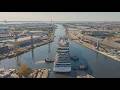
The Costa neoRiviera, which departed from Tarragona for the first time on June 2nd, has docked in the city 17 times, allowing its passengers to experience the Balearic Rhythm, one of Costa Cruises' most popular Western Mediterranean itineraries. To date, nearly 29,000 passengers have enjoyed this itinerary, generating an estimated economic impact of €2,200,000. Almost 70% of the passengers who chose this itinerary, mostly Spanish and Italian, disembarked and visited Tarragona and its surroundings. Many of them enjoyed the opportunity to explore the region's rich cultural, artistic, and natural heritage, as well as PortAventura World.
2018. Costa Victoria from Tarragona
Costa Cruises' operations in Tarragona will continue in 2018. Following the positive results achieved this season and thanks to the successful collaboration with local entities and partners, the company will resume operations from Tarragona as its home port starting in June 2018, with an increased number of sailings. Costa will offer this itinerary 17 times a year, featuring the addition of a new ship, the Costa Victoria, with a larger capacity – 2,300 passengers compared to approximately 1,700 for the Costa neoRiviera. The itinerary, which will be similar to the one operated in 2017, including Savona, Ibiza, Mahón, and Palma de Mallorca, will feature a change: Porto Torres will be replaced by Olbia, also located in Sardinia. With this modification, the company offers passengers the opportunity to explore one of the island's most exclusive and enchanting areas, the Costa Smeralda, located on its northern coast.
The arrival of the Costa Victoria at the Port of Tarragona demonstrates Costa Cruises' continued commitment to the city. Costa will increase its current capacity by 34%, meaning that by the end of 2018, up to 39,000 passengers, in transit or embarking, will visit the city, thus increasing the economic impact on the area.
During his speech, the president of the Port of Tarragona, Josep Andreu, thanked all those involved in making the Costa Cruises project a reality, especially the Port Authority employees. He also expressed hisgratitude to Costa Cruises for the confidence they have placed in Tarragona and the Costa Daurada, and shared hissatisfaction that the company will be bringing more passengers next season, replacing the Costa neoRiviera with the Costa Victoria, which has a capacity of 2,300 passengers, more than the ship arriving this season. He added that the Port of Tarragona will thus continue to contribute to boosting the local economy.
For his part, Raffaele D'Ambrosio, Managing Director of Costa Cruises for Spain and Portugal, stated: “Starting operations as a homeport in a new location and making it a success has been a collaborative effort. Costa Cruises extends its gratitude to the Port of Tarragona, all the institutions and organizations that have collaborated with us, as well as to travel agents, for their trust and support in making this project a reality. We are now ready for next year, with a wider range of accommodations, so that Tarragona can continue to position itself as one of the leading destinations in the Western Mediterranean.”