
Source: El País
- The 1.1 million cruise passengers who stop over only spend 4.3 hours in Barcelona
- Cambra will meet soon with Mayor Ada Colau
- The Port identifies the challenge of attracting more cruise ships to use it as a home port
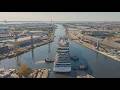
With the debate on the current tourism model high on the agenda of Mayor Ada Colau, who has led the city government since May, the Port of Barcelona and the University of Barcelona presented a report on Tuesday about the economic impact of cruise ships docking in the Catalan capital. This sector brings 1.8 million visitors to the city each year and has positioned the Port of Barcelona as the fourth largest homeport, departure, and arrival port for cruise ships.
The four main figures of the study are as follows: cruise ships docking in Barcelona generate direct and indirect spending of almost 800 million euros per year (2.2 million per day, 70% in the city), which represents a contribution of 413 million to the Catalan GDP, 152 million in taxes and employ the equivalent of 7,000 full-time workers.
One of the study's authors, Jordi Suriñach, an economist at the AQR Laboratory of the University of Barcelona, asserted that the work is groundbreaking in Europe. Interestingly, and despite the sector's importance, its impact had never been measured before, he emphasized. Regarding spending, Suriñach specified that direct spending (€442 million) corresponds to that of cruise lines, passengers, and crews; and indirect spending (€353 million) to their suppliers (for example, purchases made by hotels that accommodate cruise passengers).
Cambra celebrated that the study “demonstrates that the cruise sector generates investment and employment” and that it is “an activity that brings growth and stability, the solid foundations for economic development.” The challenge, he said, is to increase the percentage of cruise ships that use Barcelona as their home port, because the economic impact is almost double that of those that make a stopover. The Port Authority president is waiting to schedule a meeting “shortly” with Colau, with whom he wants to “assess the aspects of the port that affect the city.” He also mentioned that he has commissioned a specific study on the environmental aspects of the sector.
Sources at Barcelona City Hall point out that the presence of cruise ships in Barcelona is one of the issues that must be addressed in the ongoing debate at the Municipal Tourism Council. “Cruise ships have positive effects on the city, but we cannot ignore the unanalyzed impacts, such as the real economic return for the city (the revenue they generate and how it is reinvested), the pollution from their stays in the port, workers' rights, and what visits and use of public spaces by cruise ship passengers and how this affects the neighborhoods.”.
The study shows how cruise activity skyrocketed in Barcelona starting in 2000 and peaked in 2011. Based on 2014 data, the total number of cruise passengers that year was 1.9 million, of whom 700,000 embarked or arrived in the city, while the remaining 1.1 million only made port calls. The study also states that these 1.1 million transit passengers spent only 4.3 hours in Barcelona. Their average expenditure was €53, compared to €202 for cruise passengers who stayed overnight in the city.
The study does not delve into the environmental impact of the sector, beyond two facts: that it generates 1.2% of the nitrogen oxides in the city's air and 0.2% of the particulate matter. Last October, Ecologists in Action and the Federation of Neighborhood Associations of Barcelona denounced the impact that cruise ships have on the city and accused the city council, then headed by Xavier Trias (CiU), of being "irresponsible" for failing to act.
The report also refers to the “catalytic effects” of cruises, such as the fact that 78% of cruise passengers who depart or dock in Barcelona arrive by plane, a circumstance “determining in the creation and maintenance of intercontinental flights” by companies such as Air Canada, Delta or American Airlines.
http://ccaa.elpais.com/ccaa/2015/09/08/catalunya/1441708985_851516.html