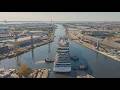

The Port of Cádiz welcomes the MSC Virtuosa, one of MSC Cruises' newly built ships, making its maiden call at the city. The vessel, delivered in February of this year, arrived in the capital after spending the summer on local cruises in the United Kingdom.

Cádiz is on the route that MSC Virtuosa has been operating since September 22nd, offering four departures from the Spanish cities of Málaga and Barcelona. The 10-day, 9-night itinerary will explore the Western Mediterranean until mid-November, when the ship will depart for Dubai. During the voyage, in addition to Cádiz, cruise passengers will enjoy tourist gems such as Lisbon, Barcelona, Marseille, Genoa, and Málaga, as well as three full days at sea.
This was the first call by an MSC Cruises ship in Cádiz in 2021, following the industry shutdown caused by the pandemic. It marks the first step in a gradual return to normalcy for MSC Cruises and its port calls in Cádiz, demonstrating the company's commitment to the city and its network of land-based tourism services.
Fernando Pacheco, Managing Director of MSC Cruises in Spain, stated, “We have long desired to return to the port of Cádiz, not only to showcase this wonderful city to our cruise passengers but also to resume working with all the authorities, companies, travel agencies, suppliers, and local entities with whom we have a long-standing and close professional relationship. Our commitment to the port and the city of Cádiz is unwavering. Undoubtedly, its climate, lifestyle, and rich cultural offerings will be a major draw for our passengers, who will be able to enjoy one of the finest cities in the Mediterranean while adhering to our health and hygiene protocols.”.
The CEO added that “Cádiz makes it very easy for us as a destination to implement our rigorous health and hygiene protocol, a pioneering initiative in the industry that has been guaranteeing safe holidays for tens of thousands of travelers worldwide for over a year. Key to this is, for example, the quality and professionalism of the local suppliers we work with to organize excursions in small, bubble groups on land.”.
Furthermore, as proof of MSC Cruises' commitment to Cadiz and the entire region of Andalusia, MSC Cruises has confirmed its attendance at CITCA, the 2nd International Cruise Tourism Congress in Andalusia, which will take place at the Auditorium of the Provincial Council of Malaga on October 21 and 22 and will serve for the cruise sector to jointly define all the challenges of 2022.
MSC Virtuosa, one of MSC Cruises' most innovative and environmentally advanced ships
MSC Virtuosa was delivered in February and is one of MSC Cruises' most innovative and environmentally advanced ships. It belongs to the Meraviglia-class generation of ships, characterized by an iconic 112-meter-long promenade with a stunning LED dome at its heart. The 19-deck ship will offer passengers of all ages the very best in dining, entertainment, bars and lounges, boutique shops, a spa and fitness center, a water park, and clubs for toddlers and teens. In addition, the new MSC Starship Club, featuring the world's first humanoid robotic bartender in a futuristic setting, is sure to be a major attraction for passengers.
These voyages aboard MSC Virtuosa are conducted in the safest way possible. MSC Cruises' industry-leading health and hygiene protocol has been ensuring the safety of tens of thousands of travelers aboard MSC Cruises ships since August 2020, when the company restarted operations in Italy.
This protocol includes testing all passengers at least twice on their cruise (before boarding and during the cruise), although those passengers with a complete vaccination schedule only need to undergo the pre-boarding test; testing the entire crew at least three times before boarding and once weekly on board; limiting shore excursions to protected "social bubble" groups; ventilation with clean air via an HVAC system; a contingency plan that, in the event of a positive case, would not overload local health infrastructure; isolation space on board and contact tracing using wristbands; the obligation to wear masks in public areas; the enforcement of physical distancing, achieved through reduced capacity on the ship, as well as constant COVID-19 monitoring.