
Since last September, Santander has a new museum located about 500 meters from the Maritime Station: FARO Santander. This cultural project, promoted by the Banco Santander Foundation, is housed in the Pereda Building, the former headquarters of Banco Santander and one of the city's most emblematic buildings.

The Pereda Building is a neoclassical building dating from 1795, overlooking the bay and declared a Site of Cultural Interest. Its large central arch, one of the iconic features of the Pereda promenade, has become the axis that guides visitors between art galleries and technology spaces.
The transformation was designed by British architect David Chipperfield, winner of the 2023 Pritzker Prize, after nine years of work. His intervention respects the original stone and wood and integrates climate control and technology into the interior without altering the facades.


The building has also achieved BREEAM sustainability certification with the highest rating, Outstanding. This speaks volumes about the project's ambition.
What can you see at FARO Santander
FARO Santander opens with three exhibitions that more than justify a visit:
- Masterpieces from the Banco Santander Collection. One of the world's most important corporate collections, built over more than 160 years, with pieces ranging from the 2nd century BC to the present day. It includes works by Rubens, Titian, El Greco, Velázquez, Goya, Picasso, and Miró, and the largest existing collection of works by José Gutiérrez Solana. It will be on permanent display, with rotating selections.
- Modern Mexico in the Gelman Santander Collection. Frida Kahlo and Diego Rivera are the main attractions. It will be on view until January 10, 2027.
- Symptomatic Surrealism: Leonora Carrington. Includes Villa Pilar, which the artist painted while she was hospitalized in a sanatorium near Santander during World War II, and Green Tea (1942), which are being exhibited for the first time.
In addition, the center features an immersive large-format projection room, an experimental space for families, an auditorium, a shop and a restaurant: Los Jardines de Faro and the Lumen restaurant, overlooking the bay.
The cultural triangle of Santander
FARO Santander is not alone. It joins a cultural hub in the bay that already boasts Renzo Piano's Botín Centre as its flagship , and which will be further enriched by the Reina Sofía Museum's associated branch and the Lafuente Archive in the former Bank of Spain building, just a few meters away. Few Spanish cities the size of Santander can boast three such institutions within walking distance.

A historic year for tourism and the Port of Santander
Cantabria closed 2025 as its best tourist year of the century, with around two million visitors and more than six million overnight stays, and the FARO Santander project alone aims to exceed 200,000 visitors per year.
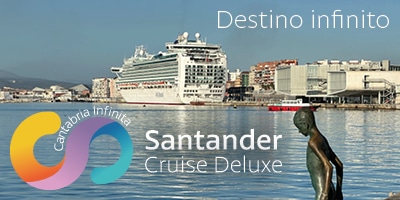
The port is experiencing a period of growth: it has increased from 21 cruise calls in 2025 to 38 in 2026, with an expected 60,000 cruise passengers. The Santander Cruise Deluxe aims to make the city the leading port for premium cruises in northern Spain, attracting cruise lines such as Cunard, Crystal, Regent, Seabourn, and Oceania.
In fact, in 2027 several luxury cruise ships from Silversea, Regent, and Cunard, among other shipping companies, will be received.
Santander by cruise ship: what to see in the city and surroundings
Beyond the cultural hub of the bay, Santander and its surroundings offer cruise passengers a remarkable variety of attractions. The port call can be enjoyed without leaving the city or by exploring some of the most beautiful corners of Cantabria.
The historic center and its museums
The Gothic-style Cathedral of Santa María de la Asunción boasts a beautiful cloister and a tower open to visitors. It forms part of the Cultural Ring, a network of small interpretation centers that trace the city's history: the remains of the medieval wall in the Plaza Porticada and the air-raid shelter in the Plaza del Príncipe, built in 1937 to protect the population during the Spanish Civil War.
The port itself holds memories of the city. At the Maritime Station, where cruise ship passengers disembark, a permanent exhibition commemorates the explosion of the steamship Cabo Machichaco in 1893, one of Santander's two great tragedies, along with the fire of 1941.


This cultural offering will be complemented by the new headquarters of the Museum of Prehistory and Archaeology of Cantabria (MUPAC), whose opening is planned for 2027. The new facility will allow the extraordinary archaeological heritage of Cantabria to be showcased and will reinforce the cultural appeal of Santander.
In the historic center we also find the Santander Art Museum (MAS), whose most prized work is the portrait of Ferdinand VII painted by Goya.
From the bay to the open sea
Following the coastline, you reach the Magdalena Peninsula, dominated by the palace that was once the summer residence of the royal family. A premium tour grants access to areas usually closed to the public, such as the royal bedrooms and stables. At its base lie the beaches of La Magdalena and Los Bikinis.


Next, the beaches of El Sardinero stretch out, with the Gran Casino and the Piquío Gardens, a classic setting for summer vacations in Santander. Further north, starting from the Cabo Mayor lighthouse, which houses an art center, begins Costa Quebrada, a UNESCO Global Geopark. Its cliffs and geological formations can be explored along a stunning coastal path.
Top-notch gastronomy
Santoña anchovies, Cantabrian fish, cheeses, and sobaos and quesadas pasiegos are the great ambassadors of Cantabrian cuisine.


Cantabria boasts six Michelin-starred restaurants, three in Santander and three in the rest of the region. Cenador de Amos, with three Michelin stars and one green star, is just 20 minutes from the city. Casona del Judío, with one Michelin star and one green star, is a short walk from the city center, while El Serbal, with one Michelin star, is located right on Sardinero Beach.
Solana, Pico Velasco and La Bicicleta, each with a Michelin star, are less than 50 minutes from the city.
In Santander, Cañadío and Bodega del Riojano also stand out, distinguished with Repsol Suns.
Excursions at 30, 60 and 90 minutes
Santander is an excellent gateway to discovering Cantabria, as many of the cultural, natural and gastronomic resources are located less than an hour and a half from the port, making it easy to organize excursions depending on the length of the stopover.
About 30 minutes away are the Cabárceno Nature Park, with more than 120 species in semi-freedom; Santillana del Mar, a medieval town next to the Altamira Museum, where you can visit the replica of the famous cave; Puente Viesgo, with its spa and the caves of El Castillo and Las Monedas, a World Heritage Site; and Comillas, with Gaudí's El Capricho.


An hour away await Castro Urdiales and its Gothic church of Santa María overlooking the sea, Laredo and its extensive beach, the Pasiegos Valleys, the amazing sequoia forest of Cabezón de la Sal and the El Soplao cave.
With a journey of an hour and a half, the Picos de Europa offer some of the most spectacular scenery in Spain. The Fuente Dé cable car climbs almost 800 meters, and in the Liébana region, the town of Potes and the Santo Toribio Monastery, which houses the Lignum Crucis (True Cross), await.
Art, history, nature and gastronomy are thus combined on a scale that hardly leaves any cruise passenger indifferent.